The Way I See It
Photographs and Writings by Gregg Waterman
Welcome to my new web page - although not as polished as my previous one, it meets the basic needs of sharing my work and allows me to redirect some personal funds to other photography related projects. In addition to sharing a collection of some of my images, I will continue to subject those who choose to some of my thoughts about photography ("Musings").
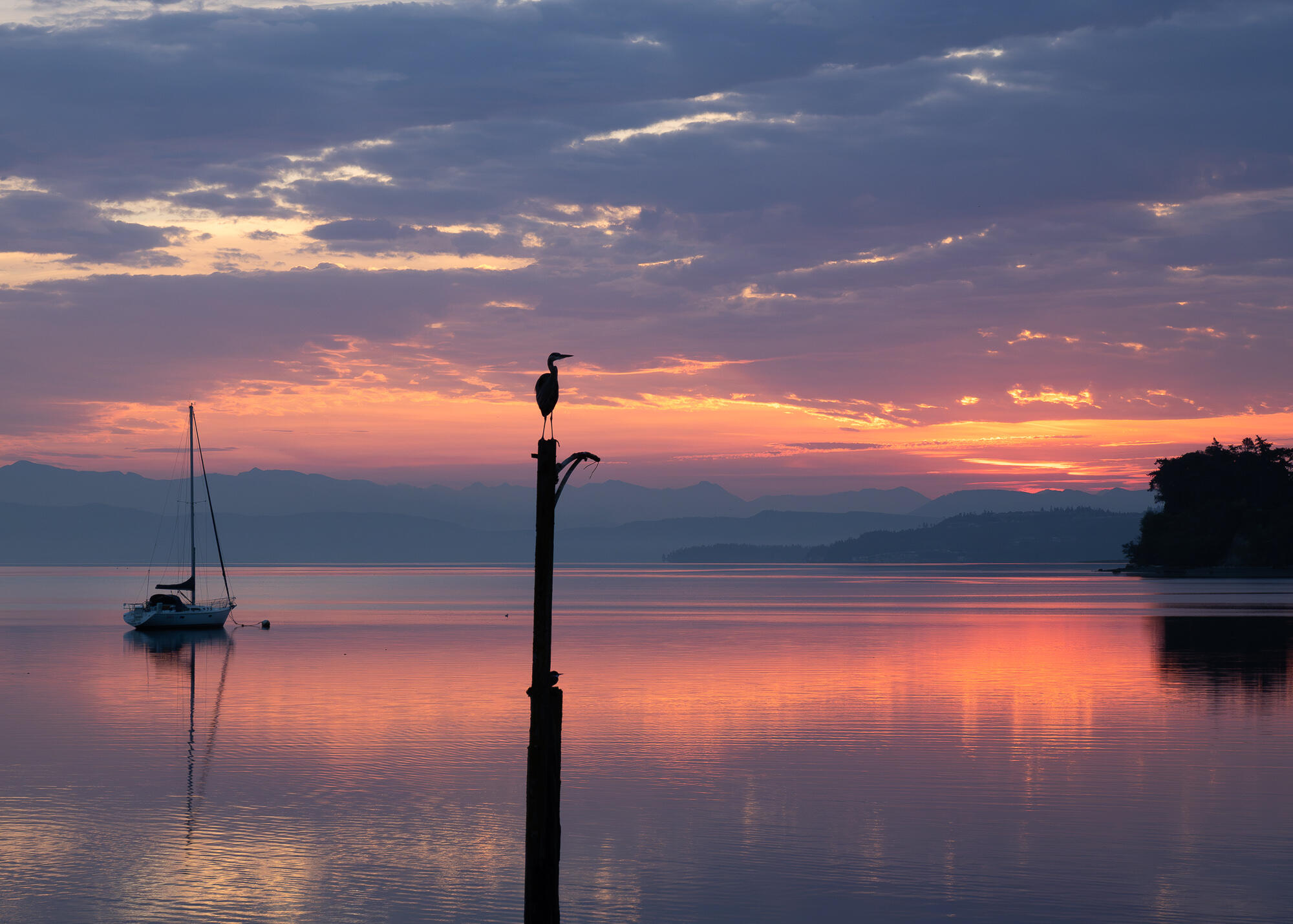
BLOG - Writings by Gregg Waterman
Welcome to my blog page! If you would like to be notified when a new post is made, please use the contact form to simply send me an email that says "subscribe me." Click here if you would like to access any old blog posts.
Click the title or image of any post to see the entire post.
The Power (and Pitfalls) of Selection 1-25-2026
…the art is in selecting what is worthwhile to take the trouble about… - photographer Berenice AbbotWhat defines photography, more than anything else, is that it is the act of placing a rectangular frame around some part of what we see, to the exclusion of everything outside that frame. Understanding and ...
The Power (and Pitfalls) of Selection
…the art is in selecting what is worthwhile to take the trouble about… - photographer Berenice Abbot
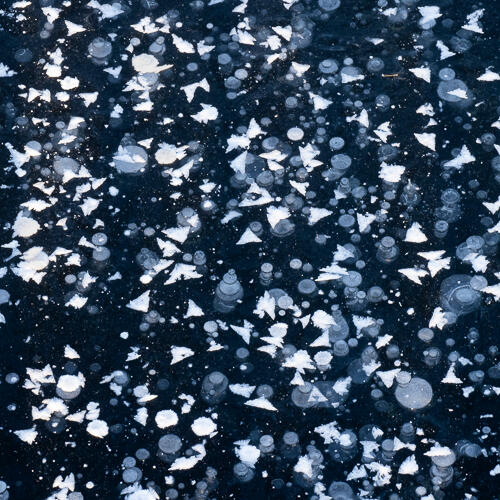
What defines photography, more than anything else, is that it is the act of placing a rectangular frame around some part of what we see, to the exclusion of everything outside that frame. Understanding and applying this idea can lead to photographs with impact well beyond the simple recording of a scene.I was out photographing recently, and had made a number of preconceived images of a particular subject. (All of which turned out to be extremely boring, illustrating the folly of planning ahead too much!) I then started poking around, and came upon some interesting ice forms. I figured they might make for a good photograph, but when I held the camera viewfinder up to my eye, I was blown away! The act of isolating just a small portion of the scene in front of me by excluding everything outside the frame of my viewfinder created an otherworldly scene. Here is the resulting photograph:
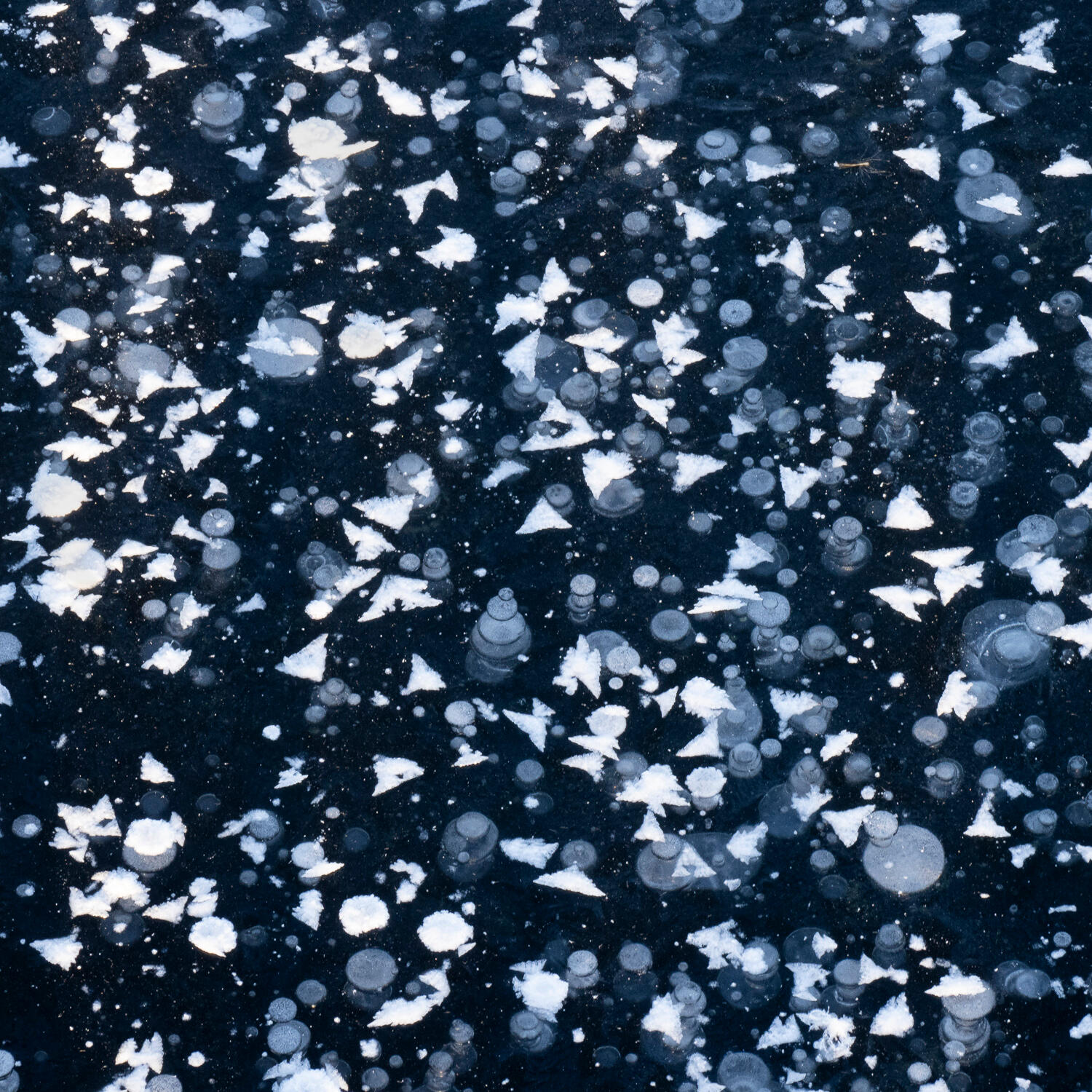
Had I photographed the ice and some of its surroundings (grasses, an irrigation gate), the result would not have had anywhere near the impact of the image above. Disregarding the importance of framing in a photograph can be disastrous. (Here I mean for for the photograph, not in any larger sense!) This is well summarized in a humorous quote by the photographer Lee FriedlanderI only wanted Uncle Vern standing by his new car on a clear day. I got him and the car. I also got a bit of Aunt Mary’s laundry and Beau Jack, the dog, peeing on a fence, and a row of potted tuberous begonias on the porch and seventy-eight trees and a million pebbles in the driveway and more. It’s a generous medium, photography.This illustrates the importance of excluding that which does not contribute to what we wish to show in our photograph, along with including in the frame everything that we DO want to show.
Addendum (September 2026): I recently attended a workshop with Arthur Meyerson, a very successful photographer. He felt that the photograph needed another element, perhaps giving some context. When I think back to what else could a\have been included inthe photograph, I'm not sure there was anything that would have enhanced the result.
About Me
Originally from Wyoming, I now make my home in Klamath Falls, Oregon. I came here for a position teaching mathematics at the Oregon Institute of Technology and, after retiring in 2018, my wife and I decided to remain in southern Oregon. We have many good friends here, and the outdoor activities available in the area make it desirable location for us to call home.Rather than centering my life around photography, I fit it in around my other interests and activities. For this reason, I don't consider myself a photographer. That is not to say that I don't pursue photography in a somewhat intentional manner, but I've limited myself to photographing when it conforms with the rest of my life and in a way that I enjoy, which often means alone in quieter places, with few or no people around. But I have recently enjoyed making photographs of people in public spaces, something new and interesting for me, photographically.
Links and Materials
Educational MaterialsBefore retiring, my career was as an educator. I have always enjoyed helping people learn things, and I've carried that on into retirement in various ways. The following were created for a series of workshops on photography at the Klamath Senior Center, in Klamath Falls, Oregon. Clicking on any of the underlined words will take you to whatever is being told about in the text. Feel free to download and print these things, share with anyone you want.
The handout that I gave out in the workshop on editing photos on your phone.
The powerpoint for Improving Your Photography 1 - Isolation and Simplification.
The powerpoint for Improving Your Photography 2 - Composition.
The powerpoint for Improving Your Photography 3 - Light and Color.
PhotographersBelow are a few of my favorite photographers, with links to places you can see their work online.Photographers Who Work in Color
Arthur Meyerson is a new favorite of mine. Much of his work is what might be considered "street photography," all color photographs. Here is his web page.
Jay Maisel is a very prolific color photographer, who is also a colorful character! Here you can find some of his favorite photos. Unfortunately, the number of photographs at his web page is so overwhelming that it is difficult to sample much more of his work.
Ernst Haas was one of the early pioneers of artistic color photography, and I find his photographs to be extremely creative. You can find some of his photos here. Try either Classic Color or New Color - under those, if you like nature, choose Creation. Otherwise, maybe choose America or New York.
Eric Meola is another photographer whose work is in the same vein as those above. Web page.
Edward Burtynsky creates large photographs of large views, with a theme of man's impact on the earth. Expect beautiful images of disturbed (and disturbing) landscapes. Web page.
Photographers Who Work in Black and White
Ansel Adams probably needs no introduction. Here is some of his work - the page is a bit tedious to navigate!
Michael Kenna does black and white photographs, usually square, often very minimal. Here is the link to his web page. I would look at either recent images, or go to the archives, find Japan, and then find Hokkaido.
Arnold Newman did environmental portraits of famous people, most in black and white. The word "environmental" means that he photographed them in an environment, and with props, that related to what they were known for. He photographed many artists, but also architects, elected officials, scientists, and others. There is no single good website to view a full selection of his images, but you can see some of his best here and here. (You may need to click "thumbnails" for the latter.)
Brett Weston photographed many subjects, all in black and white. His images are generally very forceful, with lots of contrast. He is perhaps best known for fairly close, somewhat abstract details, and, of course, for the fact that his father was the even better-know photographer Edward Weston. A very good collection of his images is here.
There are any number of other photographers who do primarily black and white landscape (both natural and human-made) and whose work I enjoy. A few of them are Mark Citret, Huntington Witherill, Brian Kosoff